
For me, this road began 9 months before I was born - in October, 1944 when I was conceived. I now know who my parents were and I have to believe that at that time, with the raging of World War II on everybody's mind and in everybody's life, that my parents, as young as they were, were overwhelmingly affected by it all. I imagine their conversations about the possibility of my father entering the service and the long term prospects of that. Would he ever return? Would he be the same person after returning? (My father did join the Navy in 1945). I imagine their need to reach out for love and closeness at the time and completely understand the beginnings of their yet to be born daughter. As an adult, I continued to wonder about who these people were and in 1982 began the search for their identity. They are now real people to me even though they are long deceased and I relish the thought of my upcoming trip to Connecticut to meet my only surviving close family member, my brother. Over the years I became heavily involved in the genealogy community, learning skills that would help me find my family. During this time I began to help others in their quest for unknown ancestors, whether they were adoptees or just someone stumbling over a brick wall. Over the past couple of years, I have become more and more involved with the Adoption and DNA communities. It has all evolved with a group of dedicated people into a new company being formed to help others find those family mysteries with the help of DNA - DNAGedcom, LLC.
We have announced the launch of a new website DNAGedcom.
Thank you, Cece Moore, my friend, colleague and mentor, for posting this to your blog YourGeneticGenealogist.
TUESDAY, JANUARY 8, 2013
Brought to you by the DNAadoption Community...DNAGedcom
I think most people know how highly I think of the work that the DNAadoption Community is doing. They are a proactive group of incredibly intelligent and talented individuals who have banded together with a common cause - to give hope to all adoptees searching for their heritage. I am proud to say that I often collaborate with members of their community and can count a handful of them among my closest colleagues.
Fortunately, for the rest of us non-adoptees, their innovative work is starting to benefit us all. The methodology that they have created for their adoption cases has recently resulted in many success stories and can be applied to most any relatively recent genealogical brick wall. They have created ways to streamline the work of autosomal DNA matching and analysis and are now offering to share this with the rest of the genetic genealogy community.
The new website DNAGedcom delivers some of the tools that are most often requested from the major DNA genealogy companies. In this first phase of development, developer Rob Warthen has recently enabled access for all users to the FTDNA Family Finder and 23andMe downloads (though he cautions users that, at this early stage, there may still be bugs to work out). Through DNAGedcom it is now possible to download a full list of your matches, including the matching segment data from both companies. Those of us who have worked extensively with autosomal DNA for genealogy, know what a huge time saver this is. For me, with over 1000 shares on my main account at 23andMe, it has saved me tens if not hundreds of hours.
Users are required to register to use the site, but it is a quick and easy process.
For Family Tree DNA's Family Finder, this means that instead of downloading the matching segments from the Chromosome Browser five at a time, it can be done all at once. You can also download a file of "In Common With" matches, which formerly had to be checked and compiled one-by-one. To use the ICW tool, you still must assign each of your Family Finder matches to a specific relationship like "Distant Cousin" (which is certainly true for the vast number of our matches) until such time that FTDNA removes that requirement for their filter. (At the 2012 FTDNA Administrators' Conference, they announced their intention to do so.)
For 23andMe, this means that instead of downloading the matching segments for Family Inheritance Advanced three at a time, it is now possible to download a file with all the matching segment data for each of your matches that you are sharing genomes with all at once. If you have a single profile on your account, the Ancestry Finder matching files will also be downloaded. I usually integrate the public matches from the Ancestry Finder file with the Family Inheritance Advanced data to create a master spreadsheet of all available matching segments for each of the profiles I manage.
There is even a place to store your spreadsheets (.csv files up to 200 KB)!
This website is still in the early development stages, but intends to continue to deliver the most often requested tools to the genetic genealogy community. In fact, there is already a full featured phase two version of the site with even more highly desirable capabilities in development. (Rob tells me that improving AncestryDNA's functionality is next on the list!) The site is currently run solely on donations and affiliate income. The website agreement can be found here and is linked to directly from the home page. Any problems with the site should be directed to support@dnagedcom.com.
There are lots of exciting plans in store over at DNAGedcom and I am thrilled to be joining the team that will be further developing this groundbreaking new site. So far, we are:
Robert Warthen - Chief Technology Officer
Karin Corbeil - Chief Operating Officer
Diane Harman-Hoog - President
James Kelley – Professional Technologist and Systems Programmer
Gaye Tannenbaum – Technology Advisor
Patty Drabing – Principal Researcher and Advisor
CeCe Moore – Genetic Genealogy Advisor
Those of you familiar with adoption search, may recognize the names of some of our top search angels there. Their experience and expertise, combined with that of our very talented technology experts has made for a powerful team.
So, go check it out, but please don't crash the server! (JK - Rob tells me it is stable.)
Fortunately, for the rest of us non-adoptees, their innovative work is starting to benefit us all. The methodology that they have created for their adoption cases has recently resulted in many success stories and can be applied to most any relatively recent genealogical brick wall. They have created ways to streamline the work of autosomal DNA matching and analysis and are now offering to share this with the rest of the genetic genealogy community.
 |
| The New DNAGedcom Site |
The new website DNAGedcom delivers some of the tools that are most often requested from the major DNA genealogy companies. In this first phase of development, developer Rob Warthen has recently enabled access for all users to the FTDNA Family Finder and 23andMe downloads (though he cautions users that, at this early stage, there may still be bugs to work out). Through DNAGedcom it is now possible to download a full list of your matches, including the matching segment data from both companies. Those of us who have worked extensively with autosomal DNA for genealogy, know what a huge time saver this is. For me, with over 1000 shares on my main account at 23andMe, it has saved me tens if not hundreds of hours.
Users are required to register to use the site, but it is a quick and easy process.
 |
| Create an Account |
For Family Tree DNA's Family Finder, this means that instead of downloading the matching segments from the Chromosome Browser five at a time, it can be done all at once. You can also download a file of "In Common With" matches, which formerly had to be checked and compiled one-by-one. To use the ICW tool, you still must assign each of your Family Finder matches to a specific relationship like "Distant Cousin" (which is certainly true for the vast number of our matches) until such time that FTDNA removes that requirement for their filter. (At the 2012 FTDNA Administrators' Conference, they announced their intention to do so.)
 |
| Family Tree DNA Tools |
For 23andMe, this means that instead of downloading the matching segments for Family Inheritance Advanced three at a time, it is now possible to download a file with all the matching segment data for each of your matches that you are sharing genomes with all at once. If you have a single profile on your account, the Ancestry Finder matching files will also be downloaded. I usually integrate the public matches from the Ancestry Finder file with the Family Inheritance Advanced data to create a master spreadsheet of all available matching segments for each of the profiles I manage.
 |
| 23andMe Tools |
There is even a place to store your spreadsheets (.csv files up to 200 KB)!
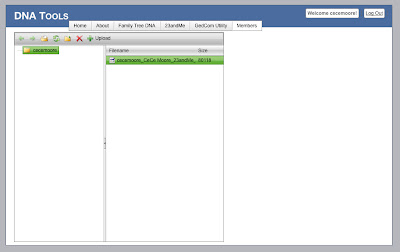 |
| Member Spreadsheet Storage |
This website is still in the early development stages, but intends to continue to deliver the most often requested tools to the genetic genealogy community. In fact, there is already a full featured phase two version of the site with even more highly desirable capabilities in development. (Rob tells me that improving AncestryDNA's functionality is next on the list!) The site is currently run solely on donations and affiliate income. The website agreement can be found here and is linked to directly from the home page. Any problems with the site should be directed to support@dnagedcom.com.
There are lots of exciting plans in store over at DNAGedcom and I am thrilled to be joining the team that will be further developing this groundbreaking new site. So far, we are:
Robert Warthen - Chief Technology Officer
Karin Corbeil - Chief Operating Officer
Diane Harman-Hoog - President
James Kelley – Professional Technologist and Systems Programmer
Gaye Tannenbaum – Technology Advisor
Patty Drabing – Principal Researcher and Advisor
CeCe Moore – Genetic Genealogy Advisor
Those of you familiar with adoption search, may recognize the names of some of our top search angels there. Their experience and expertise, combined with that of our very talented technology experts has made for a powerful team.
So, go check it out, but please don't crash the server! (JK - Rob tells me it is stable.)

